
Executive functioning refers to a set of mental skills that allow us to plan, focus, remember instructions, and manage our behavior in everyday life. Think of it as the brain’s coordination system—the part that helps you decide what to do, in what order, and how to stay on track when things get complicated.
When these skills are working well, most people don’t notice them. When they’re not, the effects tend to show up everywhere: at school, at work, in relationships, and in how someone handles even routine daily demands.
Key Takeaways
- Executive functioning includes three core skills: working memory, inhibitory control, and cognitive flexibility.
- These skills continue developing into the mid-20s, which is why challenges can look different in children, teens, and adults.
- Executive functioning difficulties are not a sign of low intelligence or lack of effort—they reflect differences in how the brain organizes and manages information.
- Many conditions, including ADHD, autism, and learning disabilities, involve significant executive functioning challenges.
- A neuropsychological evaluation can help identify the specific nature and profile of executive functioning difficulties, which in turn guides meaningful support.
The Three Core Skills Behind Executive Functioning
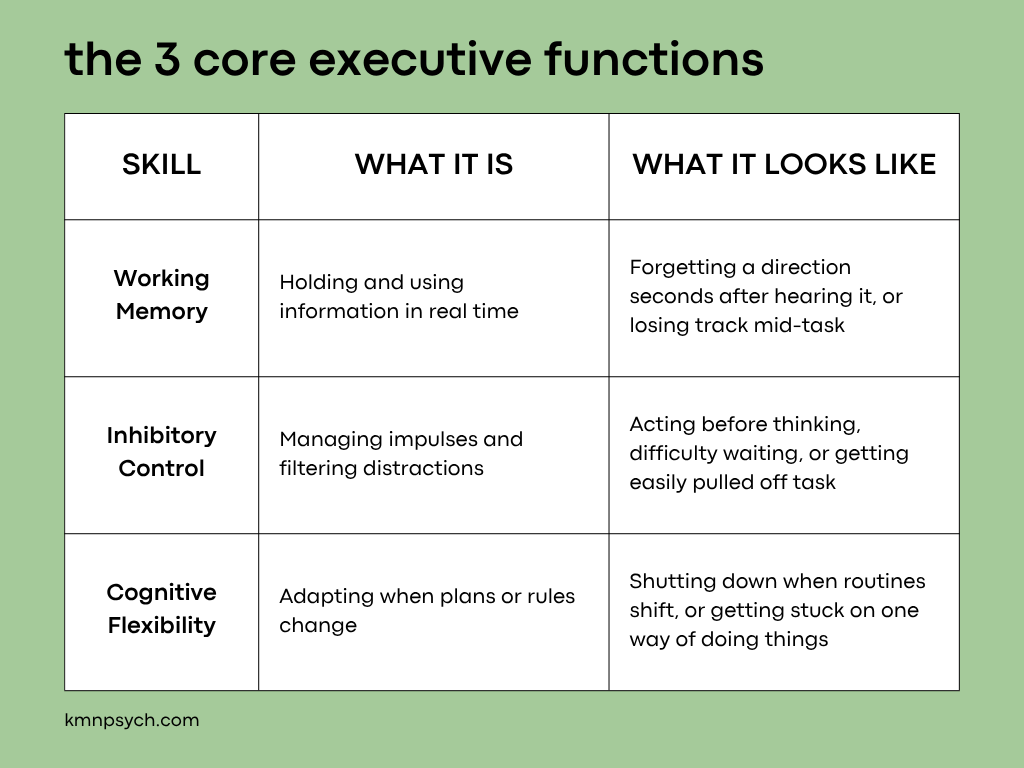
Researchers generally agree on three foundational components of executive functioning. Each one plays a distinct role, though they work closely together in practice.
- Working memory is the ability to hold information in mind and use it in real time. It’s what allows you to follow a multi-step direction, keep track of where you are in a task, or remember what someone just said while you’re still processing it. It’s not the same as long-term memory; it’s more like a mental workspace that you’re actively using moment to moment.
- Inhibitory control is the ability to manage impulses, filter out distractions, and regulate emotional and behavioral responses. It’s what helps someone pause before reacting, stay focused in a noisy environment, or resist the urge to abandon a task before it’s finished.
- Cognitive flexibility refers to the ability to shift between tasks, adapt to changing rules or expectations, and approach problems from a new angle when the first approach isn’t working. It’s what makes transitions manageable and problem-solving more creative.
These three skills don’t operate independently. When one is underdeveloped, it tends to create pressure on the others — which is part of why executive functioning challenges can look so varied from person to person.
How Executive Functioning Develops Across the Lifespan
Executive functioning isn’t something you either have or don’t. It develops gradually, beginning in early childhood and continuing well into young adulthood. Research published in Scientific Reports found that working memory continues to improve through adolescence and into the early 30s, while inhibitory control shows early signs of decline as early as the mid-30s.
This developmental window matters a great deal when trying to understand someone’s difficulties. A 10-year-old who struggles to stay on task is at a very different point in exectuve function development than a 17-year-old or a 35-year-old with the same complaint. What looks like immaturity in a younger child may reflect a meaningful developmental gap in a teenager—and what looks like distraction in an adult may reflect a lifelong pattern that was never formally identified.
Executive funtion skills also don’t develop at exactly the same rate across all three domains. Cognitive flexibility tends to emerge earlier; working memory and inhibitory control continue refining well into early adulthood. This is one reason a thorough evaluation looks at each area separately rather than treating executive functioning as a single score.
What Executive Functioning Challenges Look Like in Daily Life
Executive functioning difficulties don’t always look the same across age groups—or even across settings. The patterns below are illustrative, not diagnostic.
In children (ages 7–12):
- Difficulty starting homework or transitions without significant prompting
- Forgetting multi-step directions shortly after hearing them
- Losing belongings regularly despite reminders
- Emotional meltdowns when routines change unexpectedly
- Trouble completing tasks from start to finish
In adolescents and teens:
- Difficulty managing long-term projects or deadlines without external structure
- Impulsive decision-making, especially under social pressure
- Trouble shifting focus between subjects or activities
- Inconsistent academic performance that doesn’t reflect effort or intelligence
In adults:
- Chronic disorganization, lateness, or missed commitments
- Difficulty sustaining attention during meetings or complex tasks
- Emotional reactivity that feels disproportionate to the situation
- Struggling to plan or initiate tasks even when motivation is present
It’s worth noting that factors like stress, poor sleep, anxiety, and illness can all temporarily impair executive functioning in anyone. A persistent, cross-setting pattern—one that shows up regardless of circumstances—is typically what prompts a more formal look.

Conditions That Commonly Involve Executive Functioning Difficulties
Executive functioning challenges don’t exist in a vacuum. They frequently co-occur with, or are central to, a range of neurodevelopmental and psychological conditions.
ADHD is perhaps the most widely recognized example. As Dr. Adele Diamond’s landmark research published in the Annual Review of Psychology established, ADHD is fundamentally a disorder of executive functioning—not simply a problem with attention or hyperactivity. Everyone with ADHD has some degree of executive functioning difficulty, though the profile varies significantly from person to person.
Executive functioning challenges also appear frequently in autism spectrum disorder, specific learning disabilities (such as dyslexia and dyscalculia), anxiety disorders, mood disorders, and in individuals with a history of concussion or traumatic brain injury.
Importantly, “executive functioning challenges” is not itself a diagnosis. It’s a description of a cognitive pattern. Identifying the underlying cause—or combination of causes—requires a fuller picture than any single symptom or school report can provide.
When a Neuropsychological Evaluation Can Help
If executive functioning difficulties are affecting someone’s daily life in a meaningful way, a neuropsychological evaluation can help clarify what’s actually going on.
This is especially true when:
- There’s a long-standing pattern of difficulty that hasn’t been fully explained
- An existing diagnosis (like ADHD or anxiety) doesn’t seem to account for everything being observed
- School performance, work functioning, or daily independence is significantly impacted
- Multiple providers have offered different or conflicting explanations
In a well-designed evaluation, testing doesn’t just confirm or rule out a diagnosis—it maps out how a person actually thinks and processes information. That includes measuring working memory capacity, inhibitory control, cognitive flexibility, processing speed, and attention across a range of standardized tasks. The result is a profile, not just a label.
Research from Brain Sciences has found that identifying specific cognitive weaknesses—including executive functioning—allows for more targeted interventions and supports. That specificity is part of what makes comprehensive testing meaningful rather than general.

What Testing Can and Cannot Tell You
A neuropsychological evaluation can tell you a great deal about how executive functioning skills are developing relative to same-age expectations, where the specific strengths and weaknesses lie, and how executive functioning difficulties may be interacting with other cognitive or emotional factors.
That information can directly inform:
- School accommodations and IEP or 504 planning
- Workplace accommodations or documentation
- Recommendations for targeted academic or therapeutic support
- Care coordination with other providers

Schedule An Appointment
If you’re noticing a persistent pattern of executive functioning challenges—in yourself, your child, or a teen you’re supporting—a neuropsychological evaluation can help you get clearer answers. To learn more about the evaluation process or schedule a consultation, contact KMN Psych today.
FAQs
Executive functioning refers to a group of mental skills—primarily working memory, inhibitory control, and cognitive flexibility—that allow people to plan, focus, manage impulses, and adapt to changing demands. The term describes how the brain coordinates and directs goal-directed behavior.
While researchers use slightly different frameworks, commonly identified executive functions include working memory, inhibitory control, cognitive flexibility, planning, organization, task initiation, and self-monitoring. The three most consistently recognized as foundational are working memory, inhibitory control, and cognitive flexibility.
Some models expand the list to include skills such as response inhibition, working memory, emotional control, sustained attention, task initiation, planning and prioritization, organization, time management, goal-directed persistence, flexibility, metacognition, and stress tolerance. These broader models are often used in educational and clinical settings to describe real-world functioning.
Common signs include difficulty starting or completing tasks, trouble following multi-step directions, poor time management, disorganization, emotional dysregulation, impulsivity, and difficulty shifting focus or adapting to change. These signs can appear across school, work, and home settings, and often look different depending on age.
Yes. A neuropsychological evaluation can assess executive functioning through a range of standardized tasks that measure working memory, inhibitory control, cognitive flexibility, processing speed, and planning. Results provide a detailed profile of strengths and areas of difficulty, which can guide school planning, workplace accommodations, and clinical recommendations.
Diamond, A. (2013). Executive functions. Annual Review of Psychology, 64, 135–168. https://doi.org/10.1146/annurev-psych-113011-143750
Diamond, A., & Ling, D. S. (2016). Conclusions about interventions, programs, and approaches for improving executive functions that appear justified and those that, despite much hype, do not. Developmental Cognitive Neuroscience, 18, 34–48. https://doi.org/10.1016/j.dcn.2015.11.005
Ferguson, H. J., Brunsdon, V. E. A., & Bradford, E. E. F. (2021). The developmental trajectories of executive function from adolescence to old age. Scientific Reports, 11, 1382. https://doi.org/10.1038/s41598-020-80866-1
Kang, W., Pineda Hernández, S., Rahman, M. S., Voigt, K., & Malvaso, A. (2022). Inhibitory control development: A network neuroscience perspective. Frontiers in Psychology, 13, 651547. https://doi.org/10.3389/fpsyg.2022.651547
Wong, E. H., Rosales, K. P., & Looney, L. (2023). Improving cognitive abilities in school-age children via computerized cognitive training: Examining the effect of extended training duration. Brain Sciences, 13(12), 1618. https://doi.org/10.3390/brainsci13121618